
Remote work
Why Remote Jobs Cluster in a Few Countries (and Where the Next Hubs Are)
Published ·Last updated
Open any remote job list and read the location line. Philippines only. Germany only. Brazil only. Poland only. And increasingly, places like Indonesia too.
Remote work was supposed to make location irrelevant. So why does where you live still decide which "remote" jobs you can apply for?
It's a pattern, and it's global. Once you see how it works, you can read a location line like a map and spot where the next hubs are forming.
What our own job board shows
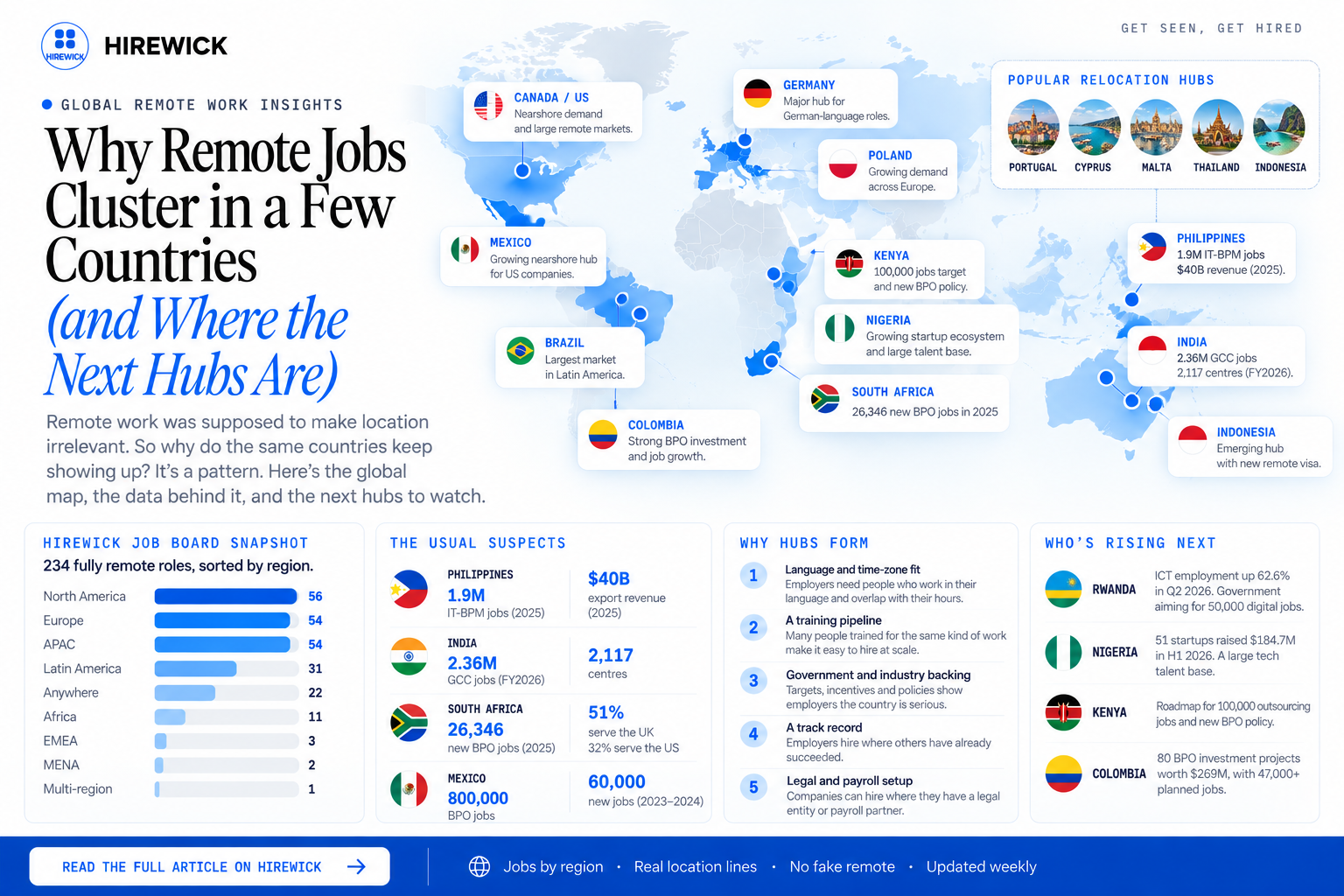
Here's a snapshot of the Hirewick board when we last counted: 234 fully remote roles. North America had 56, Europe 54, APAC 54, Latin America 31, "Anywhere" 22, Africa 11, and a handful more across EMEA, MENA and multi-region.
The first surprise: only about 1 in 10 roles (22 of 234) was open to applicants anywhere in the world. The rest came with a country attached.
The second surprise is what's inside those regional totals:
- • APAC: roughly half of the roles were Philippines-only. India, Pakistan and Australia made up most of the rest, and newer places such as Indonesia are starting to appear in location lines.
- • Europe: about a third of the roles were Germany-only, and most of those were German-language. The UK, Poland, Spain and the Netherlands followed.
- • Latin America: mostly Brazil, Colombia and Mexico.
That's not random. It's the map of where employers have built, and keep building, remote teams.
Two kinds of hubs
It helps to separate two very different things:
- 1. Delivery hubs: places where employers build teams, because the talent, language, time zone and infrastructure are there.
- 2. Relocation hubs: places where workers choose to live, often on a visa made for remote work, while working for someone else.
Delivery hubs around the world
The Philippines is the benchmark. Its IT-BPM sector employed about 1.9 million people at the end of 2025 and brought in roughly $40 billion in export revenue, with 2026 projected near $42 billion (VAMasters).
India has turned outsourcing into something bigger: global capability centres, where companies build their own in-house teams. India had 2,117 of them in FY2026, employing about 2.36 million people (Flexiple, citing Zinnov and Nasscom). Those centres are on track to hire about 510,000 people in 2026, and 64% of the new roles call for AI, data science or automation skills (Outsource Accelerator).
Poland and Central Europe are Europe's business services engine. At the end of Q1 2026, Poland had 2,179 service centres belonging to 1,303 companies, and the sector reached a record 6.1% of the country's GDP (Europa Property, citing ABSL). ABSL expects new jobs in 2026 particularly in centres serving the German and Scandinavian markets (XYZ). That's one reason so many European roles on our board ask for German.
Latin America is the nearshore story for US companies, thanks to overlapping time zones. Mexico's sector employs about 800,000 people and added roughly 60,000 net new jobs across 2023 and 2024 (StealthAgents, citing AMITI). Colombia logged 80 BPO investment projects worth $269 million, with more than 47,000 planned jobs over five years (StealthAgents, citing ProColombia). Brazil is the region's largest market by revenue, much of it in Portuguese-language work (StealthAgents, citing Statista).
South Africa is the English-speaking hub on the African continent. It created 26,346 new BPO jobs in 2025, its most since 2018, with about 90% going to young workers (Outsource Accelerator). About 51% of its jobs serve the UK and 32% the US (EWN).
Why hubs form: five ingredients
Hubs aren't random. They tend to have:
- 1. Language and time-zone fit. Employers need people who work in their language and overlap with their hours. German-speaking roles cluster in Germany, US-facing roles in Mexico and Colombia.
- 2. A training pipeline. Many people trained for the same kind of work make it easy to hire 50 at once.
- 3. Government and industry backing. Targets, incentives and policies tell employers a country is serious.
- 4. A track record. Employers hire where others have already succeeded.
- 5. A legal and payroll setup. This one is the least talked about. The remote job market is increasingly limited by compliance, not by employers' reluctance to hire remotely (StayWise). If a company has a legal entity or payroll partner in a country, that's where it can hire.
Notice what's missing from that list: talent. Talent exists everywhere. Hubs form where talent is visible, trained, backed and legally hireable.
Relocation hubs: where people move to work remotely
A different group of places shows up in the news and on job lists: Portugal, Thailand, Indonesia, Cyprus and Malta. They're less about employer-built teams and more about relocation. More than 48 jurisdictions now offer digital nomad or remote work visas (EY).
Portugal is the big one. The national statistics office counts about 1.6 million foreign citizens living in Portugal, around 14% of all residents (Portuguese Government). Growth has cooled sharply, though: only about 59,000 new foreign residents were added in 2025, the smallest rise in nine years, compared with about 326,000 in 2022 and 276,000 in 2023, after the government ended a fast-track route in 2024 (same source). Its digital nomad visa has asked for income of around four times the Portuguese minimum wage, roughly €3,040 a month when last widely reported (Business Standard), so check the current figure.
Thailand launched its Destination Thailand Visa on 15 July 2024 (The Thaiger). It's a five-year, multiple-entry visa with stays of up to 180 days at a time, a fee of 10,000 baht (about $284), and room for a spouse and children (ASEAN Briefing). It drew more than 35,000 applicants in its first year (Business Standard).
Indonesia introduced its E33G Remote Worker Visa in 2024: a one-year permit for people who work for companies outside Indonesia, with a minimum foreign income of about $60,000 a year (WFA). Bali's remote-work scene is famous, but uptake of the formal visa has been limited, many people work on tourist or social visas, and enforcement against that has tightened in 2025 and 2026 (Grey). Indonesia also taxes residents on worldwide income, so look into the tax side before you move (Emerhub).
Cyprus and Malta are the English-speaking Mediterranean options. Malta asks applicants to show gross remote income of €3,500 a month, and Cyprus caps how many digital nomad visa holders it admits at once (Remote Work Europe).
The takeaway: a visa to live somewhere is not the same as being eligible for a job there. These visas generally let you work for an employer or clients abroad, but a role that says "Portugal only" or "Indonesia only" usually means you must already have the right to work there. Read the location line first, then check the visa, income and tax rules for your own situation before you move. We're not immigration or tax advisers.
Who's rising next
The next hubs tend to be the places that start doing the things above, early:
- • Kenya: a new Outsourcing Alliance is working toward a roadmap of 100,000 outsourcing jobs (Unity Connect), and the Cabinet approved a national BPO policy this year (Outsource Accelerator).
- • Rwanda: ICT employment rose 62.6% in Q2 2026 compared with a year earlier, from about 12,000 to 19,000 workers. That's a small base, but it was the fastest growth of any sector (AU-Startups).
- • Colombia: the investment pipeline above shows a hub still expanding, with tens of thousands of jobs planned.
- • Nigeria: 51 startups raised a combined $184.7 million in disclosed funding in the first half of 2026 (Nairametrics). Other trackers report different totals, so treat it as a sign of activity, not an exact figure.
What this means for you, wherever you are
- 1. Read the location line first. "Remote" with a country attached is not the same as worldwide.
- 2. Treat language as a hub-maker. German, Dutch, French, Spanish, Portuguese and Japanese skills open doors that English alone doesn't.
- 3. Match your time zone. Many roles are tied to US, UK or Australian hours for a reason.
- 4. Mind the work-rights gap. Living somewhere on a remote worker visa is different from being hireable by a local employer.
- 5. Aim where the growth is. Hubs keep moving up the value chain, from phone support toward AI, data and specialist work.
- 6. Use listings that are honest about location. Our job board only lists roles that state a location, and sorts them by region so you can see where the work is open.
A note on the numbers
Industry bodies and trackers don't always agree, especially on revenue and funding, and some of the figures above come from secondary reports. Visa rules and income thresholds also change often. The board counts come from our own snapshot. We've linked every source so you can check for yourself.
Ready to find your zone? Browse the Hirewick job board, or book a free call and we'll help you build a plan that fits where you are.
Get hand-checked remote jobs every week.
Join the free Weekly Shortlist: real remote roles, checked by a human, straight to your inbox or WhatsApp.
Want help putting this into practice? See our coaching packages or try the free ATS CV keyword checker.
Related articles
Job search
Why Every Role on Our Job Board Is Less Than 7 Days Old
Fully remote roles posted in the last 7 days, sorted by region and linked straight to the employer. Here is how the Hirewick job board works and why we built it.
Job search
The Hirewick Job Board Is Live: We Found the Jobs Your Feed Never Showed You
Many great roles never show up in one place. They're scattered across job boards, personal profiles, communities and word of mouth. The new Hirewick Job Board searches everywhere and brings them together, verified and sorted for you.